What To Expect on the ACT Writing Test (2026)
Sara Laszlo2026-08-21T13:31:35-07:00The ACT Writing Test is the final, optional section of the ACT. If you decide to take it, you’ll have 40 minutes to write one essay.
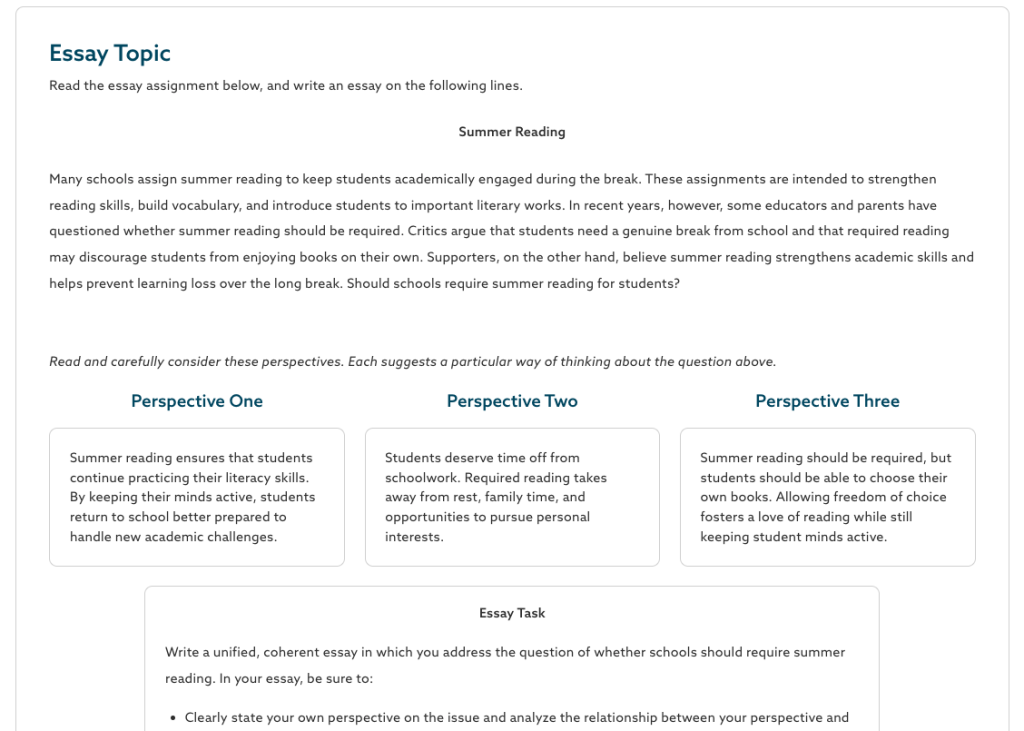
You’ll be given a description of a complex issue followed by three different perspectives on that issue. You’ll be asked to state your own perspective (you may adopt one of the three provided or introduce one of your own) and analyze how it relates to at least one of the other perspectives offered.
There is no right or wrong answer. ACT is not evaluating you on which perspective you choose; it is evaluating you on how well you articulate and support your argument. Your goal is to produce a well-reasoned, clearly organized essay.
Unlike the other sections of the ACT, the Writing Test has not changed as part of the 2025/2026 enhancements.
How is the ACT Writing Test Scored?
The ACT Writing score is reported on a scale of 2–12, and is not part of the ACT Composite score. However, if you take the ACT Writing Test, you’ll also receive an English Language Arts (ELA) score that reflects your performance across English, Reading, and Writing. You can learn more about how the ELA score is calculated here.
The Four Writing Domains
Your essay is scored across four writing domains, each on a scale of 2–12. Your overall writing score is the rounded average of the four.
Ideas and Analysis: You’ll be evaluated on how well you understood the issue in the prompt, how meaningfully you engaged with multiple perspectives, and whether your ideas were relevant to the topic.
Development and Support: You’ll be evaluated on how effectively you developed and supported your argument, backed your ideas with examples, and explored the implications of your thinking.
Organization: You’ll be evaluated on how clearly you structured your essay, whether the relationship between your ideas was easy to follow, and how effectively you guided the reader through your argument.
Language Use and Conventions: You’ll be evaluated on how effectively you used grammar, syntax, vocabulary, and mechanics to express your ideas and establish an appropriate style and tone.
ACT has published sample essays on their website to illustrate what strong and weak responses look like. Visit the sample essays page to understand what they’re looking for.
How is the Writing Test Graded on the Paper ACT?
If you take the ACT Writing Test on paper, you’ll handwrite your essay. Two trained readers will read your essay and each assign a score from 1–6 for the four writing domains. The two scores for each domain are added together, giving you a domain score between 2–12. Your overall writing score is the rounded average of the four domain scores.
Note: If the two readers disagree by more than one point on any domain, a third reader will step in to resolve the discrepancy.
How is the Writing Test Graded on the Online ACT?
If you take the ACT Writing Test on the computer, you’ll type your essay, which will be scored by CRASE, ACT’s automated scoring engine. CRASE first evaluates your essay to determine whether it can assign a score with high confidence. If it can, it will assign a score of 2–12 for each domain. If it cannot, your essay will be sent to human readers. A random sample of all essays are also reviewed by human readers as part of ACT’s quality assurance process.
Note: State, district, and international ACT administrations pair one human reader with CRASE.
Do I Have to Take the ACT Writing Test?
No, unless you are required to for graduation or are applying to a school or program that requires it.
As of spring 2026, only a handful of colleges in the United States require or encourage ACT Writing. Requirements can change from year to year, so check directly with any schools, programs, or scholarships you’re applying to.
Some states, districts, or schools also require the ACT Writing Test for graduation. If you are taking the ACT through your school, check with your counselor to find out whether your test will include the Writing section.
If You Decide to Take It, Don't Take Science the Same Day
The enhanced ACT has two optional sections: Science and Writing. When you register, you can choose to add Science, Writing, or both.
If you decide to take both optional sections, we recommend doing them on separate test dates. The ACT is already a long test, and the Writing section comes last. The essay also requires a different kind of mental effort than the multiple-choice sections that precede it. After three multiple-choice sections, you’ll have more focus and energy for the essay than you would after four.
Your Guide to the Enhanced ACT
This post is part of our comprehensive series on the 2025/2026 ACT updates. Explore our guides for every section of the new test:
Enhanced ACT Practice
Get ready for the new ACT format with 10 full-length practice tests. Try a free sample test today.

Sara Laszlo
Sara Laszlo has nearly ten years of experience in private tutoring. An opera singer by training, Sara is especially interested in exploring better ways to practice and improve skills, whether musical or test-related. She holds a B.A. in Classical Civilization from Duke University and a Certificate of Merit in Voice from the New England Conservatory of Music.
Originally published on February 11, 2020. Updated on April 13, 2026.