What To Expect on the Enhanced ACT English Test (2026)
Sara Laszlo2026-03-27T08:41:24-07:00The ACT English Test is the first section of the ACT and is designed to assess students’ ability to revise and edit written texts. Students have 45 minutes to answer 50 questions.
Rather than testing isolated grammar rules, the section is passage-based and asks students to step into the role of an editor and select revisions that improve clarity, organization, and tone, or that correct errors in grammar and punctuation.
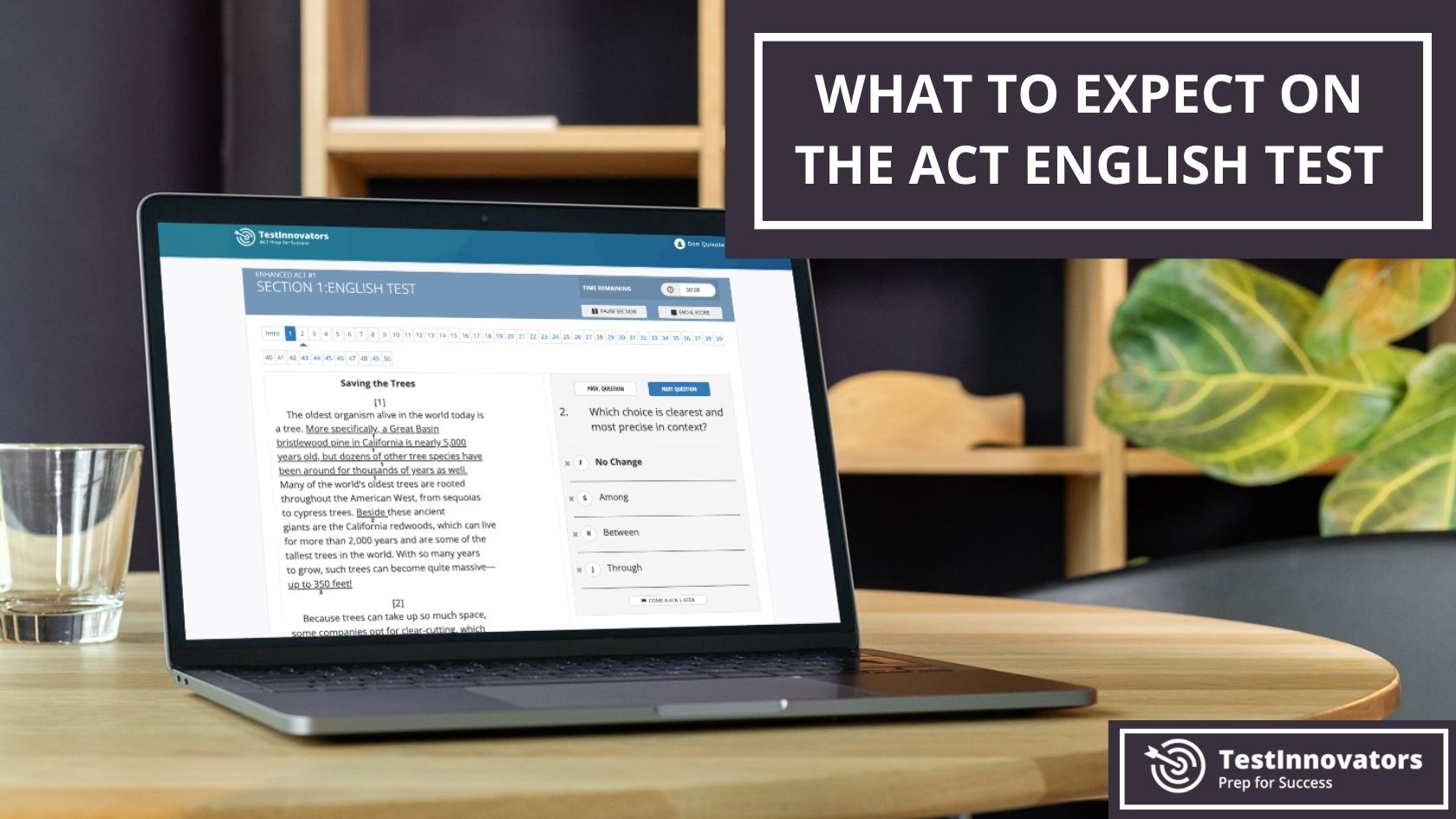
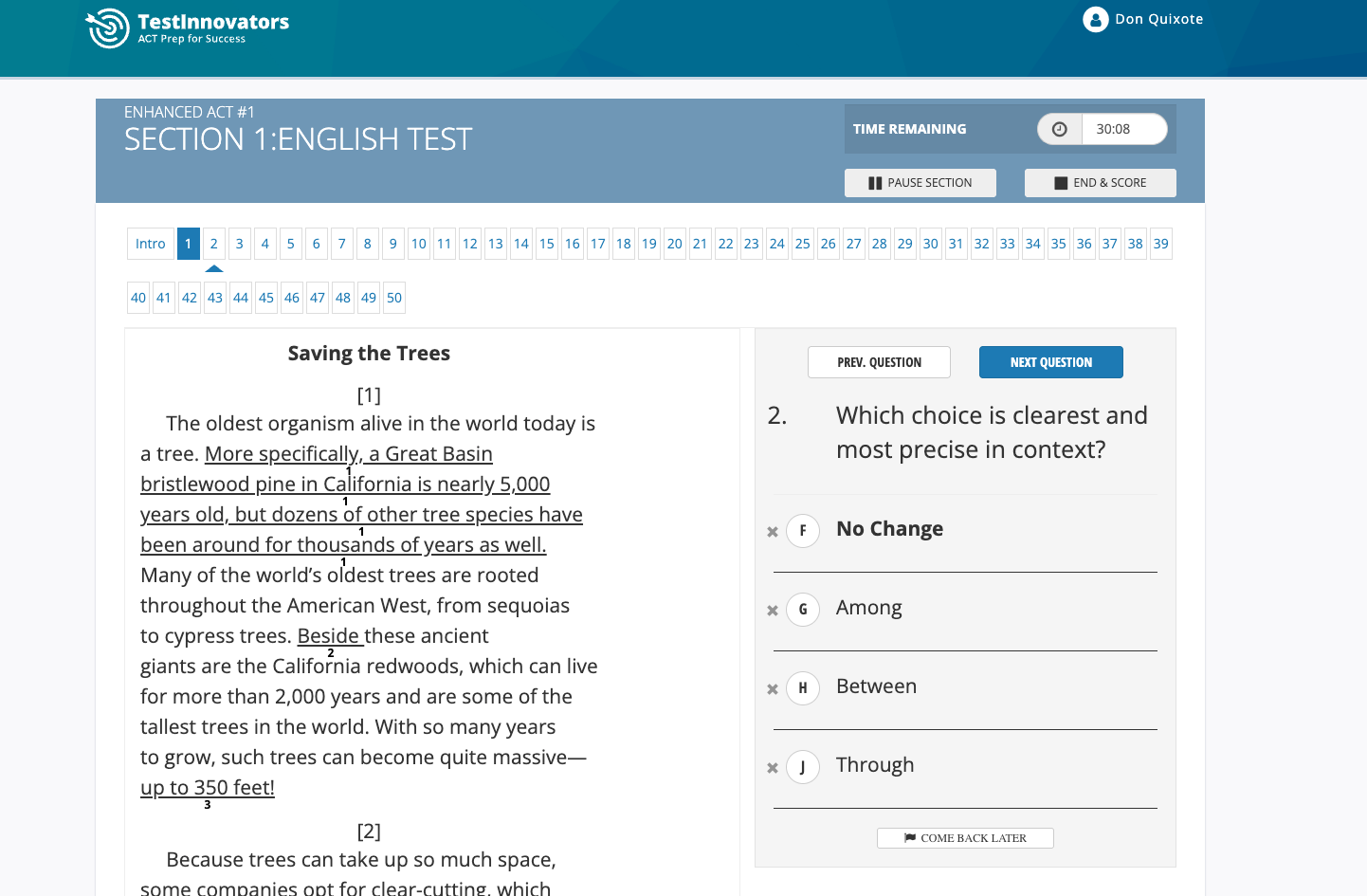
Each passage is presented as a draft in need of revision, with underlined words, sentences, or larger sections embedded throughout the text. Questions refer to these underlined portions and ask students to evaluate proposed revisions or decide whether the original wording should be retained. To be successful on the English Test, students must consider sentence-level issues, such as grammar and punctuation, as well as broader questions of organization, coherence, and rhetorical effectiveness within the passage as a whole.
ACT English Passages
Number and Length of Passages
The ACT English Test consists of 6 or 7 passages, each presented as a draft with 5 or 10 embedded questions. Passage length varies, with a mix of longer passages of approximately 340 words and shorter passages of approximately 185 words.
On test day, 5 of the passages are operational and count toward students’ scores. The remaining 1 or 2 passages are part of an embedded field test and do not count toward the score. There is no way to distinguish field test passages from operational passages.
ACT English Passage Length Breakdown
- Total passages: 6–7
- Operational (scored) passages: 5
- 3 longer passages (~340 words) with 10 questions each
- 2 shorter passages (~185 words) with 5 questions each
- Field test (unscored) passages: 1–2
- 1 longer passage (~340 words) with 10 questions, or
- 2 shorter passages (~185 words) with 5 questions per passage
Passage Types and Genres
The passages on the ACT English Test represent a mix of writing styles and genres and include informational, argumentative, and narrative passages. Any of these passage types may be longer or shorter in length.
ACT English Passage Type Breakdown
- Informational passages (2–3 operational passages): these passages present topics drawn from a wide range of subject areas, including the humanities, social sciences, and natural sciences.
- Argumentative passages (1–2 operational passages): argumentative passages take a clear position on a focused issue and are written to be approachable for all test takers. While they present a point of view, they avoid highly technical subject matter or charged political topics, instead relying on examples and reasoning that do not require prior background knowledge.
- Narrative passage (1 operational passage): the narrative passage is typically a literary text drawn from fiction or memoir and often features a first-person perspective. These passages focus on personal experiences or events and are written to be engaging and straightforward in content.
The 1 or 2 field test passages may fall into any of these categories.
Questions and Reporting Categories
There are 50 total questions on the ACT English Test, of which 40 are operational and 10 are unscored field test questions. These questions fall into three broad categories, each representing a different set of writing and language skills assessed throughout the section.
Production of Writing
The Production of Writing category accounts for approximately 38–43% of the ACT English Test, with 15–17 operational questions in this area. Questions in this category focus on how content and organization work together to support a passage’s purpose and meaning. Students are asked to evaluate revisions that affect the development of ideas, the logical flow of the text, and the overall clarity of the passage.
Rather than focusing on sentence-level correctness, these questions require students to consider how changes influence the structure and coherence of the passage as a whole.
Skill Categories
- Topic Development — Purpose and Focus: questions in this area address whether a passage’s ideas are clearly developed and aligned with its intended purpose. Students may be asked to evaluate revisions that strengthen focus, add or refine supporting details, or remove information that distracts from the main point of the passage.
- Organization, Unity, and Cohesion: questions in this area focus on how ideas are arranged and connected within a passage, including the logical ordering of sentences and paragraphs, the effective use of transitions, and the placement of introductions and conclusions to help the passage read smoothly and coherently.
Knowledge of Language
The Knowledge of Language category makes up approximately 18–22% of the ACT English Test. Students should expect to see 7–9 operational questions in this area. Questions in this category focus on clarity, precision, and stylistic effectiveness at the sentence and passage level.
Skill Categories
- Expressing Ideas Clearly: questions in this area focus on clarity and precision in language use. Students may be asked to evaluate revisions that eliminate redundancy or wordiness, refine phrasing, or choose vocabulary that conveys meaning more accurately.
- Style: questions in this area address how language choices contribute to a consistent and appropriate style within a passage. Students may be asked to consider tone, word choice, and sentence construction to ensure that revisions align with the purpose of the passage and remain consistent throughout the text.
Conventions of Standard English
The Conventions of Standard English category makes up approximately 38–43% of the ACT English Test, with 15–17 operational questions in this area. Questions in this category focus on grammar, usage, and punctuation as they appear in sentences and, at times, across multiple sentences.
Skill Categories
- Sentence Structure and Formation: questions in this area focus on grammar. Students may be asked to recognize and correct grammatical issues in complex sentences, sometimes requiring consideration of the surrounding context.
- Usage Conventions: questions in this area focus on standard English usage, including evaluating word choice and grammatical relationships in sentences where relevant elements may not appear next to one another.
- Punctuation Conventions: questions in this area ask students to identify and correct punctuation errors in sentences.
Recent Changes to the English Test
For educators and students familiar with the legacy ACT (discontinued in 2025), the enhanced ACT introduces several updates to how questions are presented on the English Test.
- All questions now include explicit directions. On the legacy ACT, some English questions relied on section-level instructions rather than individual question prompts. On the enhanced ACT, every question includes a clear question stem that specifies the task students are being asked to complete.
- Idiomatic language is no longer explicitly tested. Questions that required students to identify or correct idioms have been removed. The Conventions of Standard English category continues to assess grammar and usage without relying on familiarity with idiomatic expressions.
- Questions framed around identifying what is not correct have been eliminated. Sentence-level questions are now framed positively, asking students to select the best option rather than identify an incorrect one. This reduces unnecessary complexity and aligns more closely with typical revision tasks.
- Paragraph-level organization is assessed differently. Students are no longer asked to reorder entire paragraphs within a passage. Instead, paragraph-level skills are evaluated through more targeted revision tasks, such as:
- selecting the most effective introduction or conclusion for a paragraph
- determining where a sentence should be placed within a paragraph
- deciding whether and where a paragraph should be divided
Your Guide to the Enhanced ACT
This post is part of our comprehensive series on the 2025/2026 ACT updates. Explore our guides for every section of the new test:
Sources
ACT. Design Framework for the ACT Enhancements. March 2025.
ACT English Practice
Originally published on January 5, 2026. Updated on February 12, 2026.

Sara Laszlo
Sara Laszlo has nearly ten years of experience in private tutoring. An opera singer by training, Sara is especially interested in exploring better ways to practice and improve skills, whether musical or test-related. She holds a B.A. in Classical Civilization from Duke University and a Certificate of Merit in Voice from the New England Conservatory of Music.