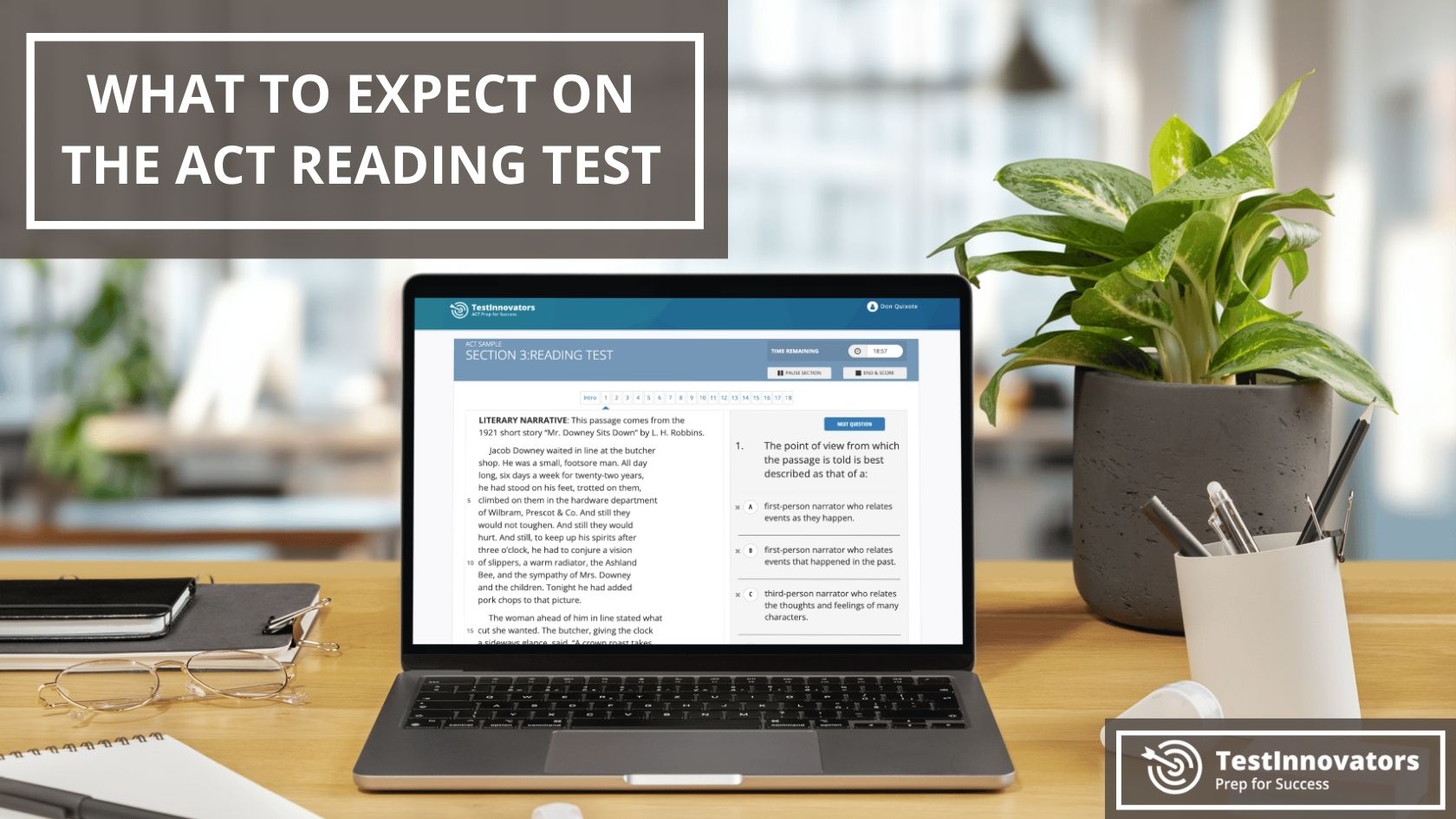
What To Expect on the Enhanced ACT Reading Test (2026)
Sara Laszlo2026-03-17T14:48:21-07:00The ACT Reading Test is the third and final required section of the enhanced ACT. It is designed to assess students’ ability to read and understand complex texts drawn from a range of subject areas. Students have 40 minutes to answer 36 questions based on excerpts from published texts.
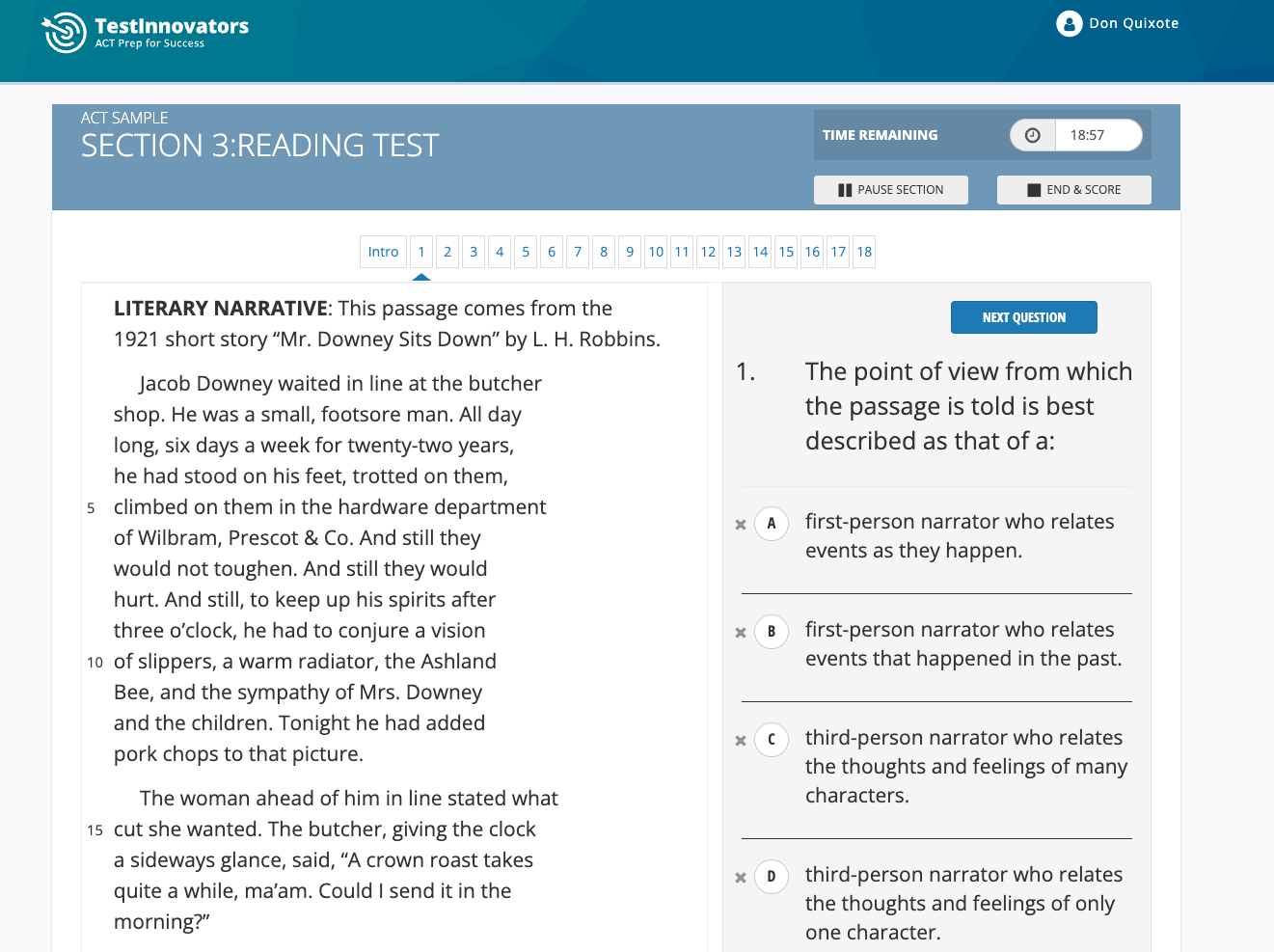
The test presents passages followed by sets of nine questions that ask students to demonstrate comprehension of key ideas, relationships between details, and the author’s purpose. To be successful on the Reading Test, students must read closely, draw logical inferences, and support their answers with evidence from the passage.
ACT Reading Passages
Number, Format, and Length of Passages
The ACT Reading Test includes three operational passages (scored) and one Field Test Passage (unscored). The Field Test Passage is indistinguishable from the operational passages.
The Three Types of ACT Reading Passages
Passages appear in one of three formats:
- Single Passages: A standalone passage drawn from a single published source.
- Paired Passages: Two shorter, related passages presented together, allowing students to consider ideas across texts.
- VQI Passages: A passage that incorporates visual or quantitative information, such as a chart or table, alongside the text. Students must interpret the visual data in the context of the written passages.
What Is the Passage Mix on Test Day?
Students won’t know the mix or order of the passages until they start the Reading section. However, all tests will have:
- 2 Single Passages (scored)
- 1 Paired Passage or 1 VQI Passage (scored)
- 1 Field Test Passage (unscored). This passage could be a Single, Paired, or VQI Passage (depending on which formats appear among the operational passages).
As a result, students will see one of the following passage format combinations on their test:
- Option 1: 3 Single Passages and 1 Paired Passage
- Option 2: 3 Single Passages and 1 VQI Passage
- Option 3: 2 Single Passages, 1 Paired Passage, and 1 VQI Passage
How Long Are ACT Passages?
Reading passages on the enhanced ACT are approximately 650 to 750 words with nine corresponding questions. Enhanced ACT passages are slightly shorter than they were on the legacy version of the test to allow for a more focused reading experience.
Here is the breakdown:
- 2 operational passages are approximately 750 words
- 1 operational passage is approximately 650 words
- Each passage is accompanied by 9 questions
ACT Passage Types and Genres
The ACT Reading Test includes a mix of literary and informational passages excerpted from published texts. These passages reflect a range of subjects, styles, and perspectives, and do not require prior subject-matter knowledge.
The operational passages include:
- 1 literary narrative passage, typically drawn from fiction or memoir
- 2 informational passages drawn from subject areas such as the humanities, social sciences, and natural sciences
The Field Test Passage may fall into either category.
ACT Reading Question Types and Skills Tested
There are 36 total questions on the ACT Reading Test, 27 of which are operational (scored) questions and 9 of which are unscored Field Test questions. ACT Reading questions fall into three broad reporting categories:
Key Ideas and Details
Key Ideas and Details questions assess a student’s ability to understand what a text says, make supported inferences, and identify important ideas developed throughout the passage. Students can expect to see 12–14 operational questions (44–52% of the Reading Test) in this category.
Skill Categories
- Close Reading: Questions in this area focus on careful attention to the text. Students may be asked to determine what a passage states explicitly or to draw conclusions that are supported by evidence from the text.
- Relationships: Questions in this area focus on identifying and understanding relationships within a passage, including relationships between individuals, events, ideas, themes, and patterns developed throughout the text.
- Central Ideas, Themes, and Summaries: Questions in this area focus on synthesizing information presented throughout the passage. Students may be asked to identify a central idea or theme, distinguish key ideas from less important details, or determine which summary best reflects the passage as a whole.
Craft and Structure
Craft and Structure questions focus on how authors use language and structure to shape meaning. Students can expect to see 7–9 operational questions (26–33% of the Reading Test) in this category.
Skill Categories
- Word Meanings and Word Choice: Questions in this area focus on determining the meaning of words and phrases based on context. Students may be asked to parse academic, technical, or figurative language as it is used within the passage.
- Text Structure: Questions in this area focus on how a text is organized and constructed. Students may be asked to analyze how an author’s structural or rhetorical choices contribute to the development of ideas or create an effect.
Purpose and Point of View: Questions in this area focus on understanding an author’s purpose and perspective. This includes analyzing stated or implied intentions, point of view, and narrative or rhetorical techniques.
Integration of Knowledge and Ideas
Integration of Knowledge and Ideas questions focus on how ideas are developed and supported within a text and, in some cases, how ideas connect across multiple texts. Students can expect to see 5–7 operational questions (19–26% of the Reading Test) in this category.
Skill Categories
- Arguments: Questions in this area focus on analyzing arguments presented in a passage. Students may be asked to evaluate claims and counterclaims, consider how evidence is used to support an argument, and determine whether the reasoning presented effectively supports the claim.
- Synthesis of Multiple Texts: Questions in this area focus on making connections across two related texts. Students may be asked to compare ideas, themes, or rhetorical structures, as well as synthesize information from both texts.
ACT Reading vs SAT Reading: Key Differences
The primary difference between the ACT Reading and the SAT Reading and Writing sections is passage length. The ACT Reading Test includes four longer passages (approximately 650–750 words), each followed by nine questions. In contrast, the SAT Reading and Writing section contains 54 short passages (approximately 25–150 words), each with one question.
The ACT’s longer passages make it possible to evaluate how ideas develop across multiple paragraphs, how structure contributes to meaning, and how individuals, events, or arguments interact over the course of a text. This format reflects the type of extended reading students encounter in upper-level high school and college coursework.
The SAT’s shorter passages allow the test makers to narrowly target specific reading and writing skills in isolation. Many students find the shorter format more approachable. Because each question is tied to a brief excerpt, students can move on quickly if a passage feels confusing.
At the same time, switching contexts between each question is its own challenge. Some students prefer staying within one passage for multiple questions, since working through the set can build understanding of the text as a whole. If they are unsure about one question, answering others in the same passage may provide helpful context.
Which test is better? Ultimately, it is a matter of personal preference. Try taking a full-length ACT practice test and a full-length SAT practice test to see which feels more natural. For a visual overview of the differences between the two tests, check out our side-by-side comparison of the Enhanced ACT and Digital SAT.
Your Guide to the Enhanced ACT
This post is part of our comprehensive series on the 2025/2026 ACT updates. Explore our guides for every section of the new test:
- What To Expect on the Enhanced ACT English Test
- What To Expect on the Enhanced ACT Math Test
- What To Expect on the Enhanced ACT Science Test
- What is the Embedded Field Test? (Coming Soon)
Sources
ACT. Design Framework for the ACT Enhancements. March 2025.
ACT Reading Pracitce

Sara Laszlo
Sara Laszlo has nearly ten years of experience in private tutoring. An opera singer by training, Sara is especially interested in exploring better ways to practice and improve skills, whether musical or test-related. She holds a B.A. in Classical Civilization from Duke University and a Certificate of Merit in Voice from the New England Conservatory of Music.