Test Prep Tips: How to Improve Your Pacing
Sara Laszlo2026-02-20T08:37:58-08:00Have you ever felt the stomach-dropping realization that you have five questions left and only two minutes on the clock?
For some students, time is the biggest challenge on tests like the SAT, ACT, ISEE, and SSAT.
Perhaps you’ve studied the content, and you understand all of the concepts. But the moment the clock starts ticking down in the testing room, your pacing falls apart and anxiety kicks in. Maybe you didn’t finish a section, but you’re confident you could have answered those last few questions correctly with just a few more minutes. If this sounds familiar, time may be the ceiling on your score.
The good news is that pacing is a skill. It’s something you can improve with the right strategies and deliberate practice. Simply telling yourself to “go faster” isn’t a strategy that holds up under pressure.
To help you break through your own scoring ceiling, let’s look at practical ways to take control of the clock.
Study Your Timing Patterns
You can’t fix what you haven’t measured. Before you try to speed up, you need to understand where and how you’re spending your time.
After every practice test, look past the number of correct and incorrect questions and pay attention to how long you spent on each question.
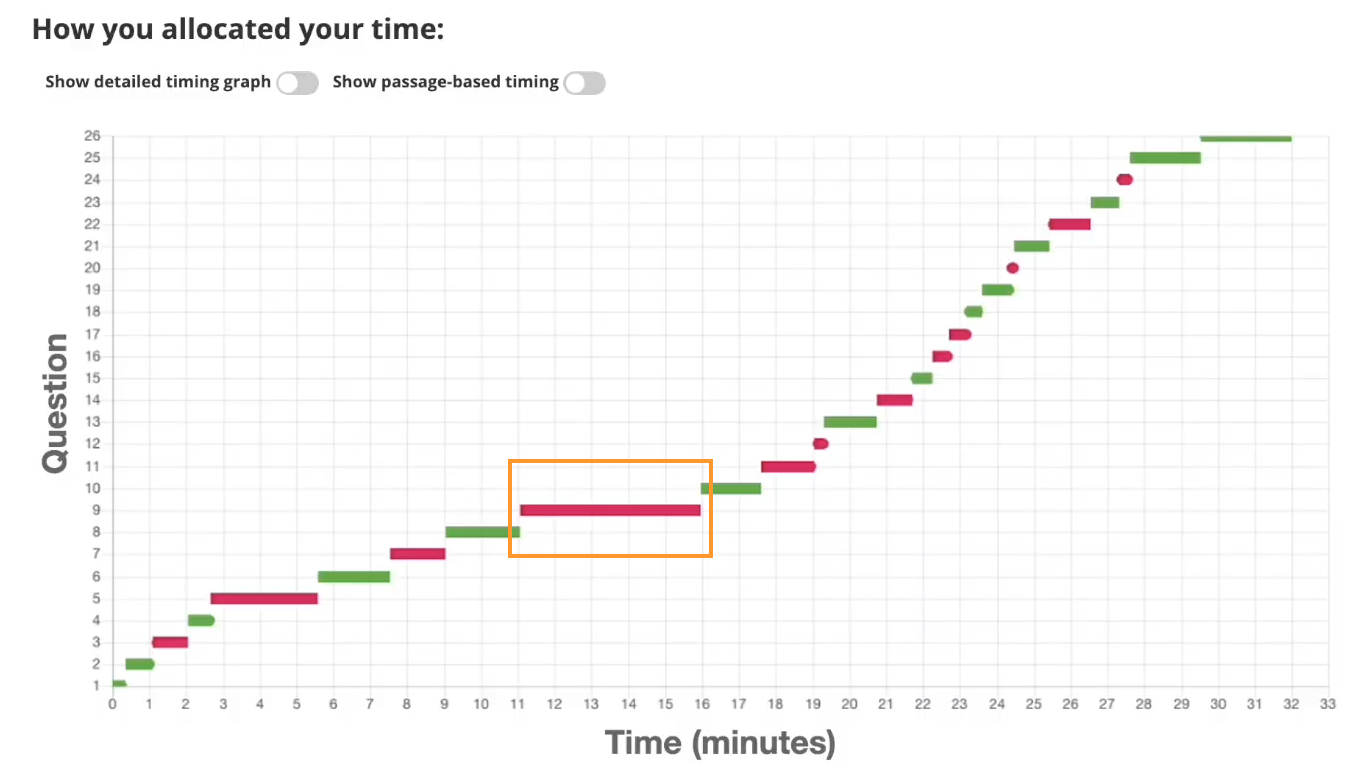
If you’re using the Test Innovators platform, you can review the timing graph at the bottom of each section summary. You can also see how long you spent on each individual question compared to the average response time in the question-by-question results.
Here’s what to look for:
1. Any Long Bars on the Timing Graph
These are the questions that took significantly longer than average. Even if you answered correctly, ask yourself why it took so long.
- Did you reread the prompt multiple times?
- Did you try a method that required extra steps?
- Did you get stuck before switching strategies?
- Did you freeze or blank out for a moment?
2. Performance Trends
Are you consistently slow on specific question types or content areas, like geometry or reading inference questions? Do certain types of reading passages slow you down? A consistent pattern may indicate that you need to do some focused content review.
A quick note: some question types naturally take longer than others. That’s why comparing your time to the average response time is helpful. It gives you context.
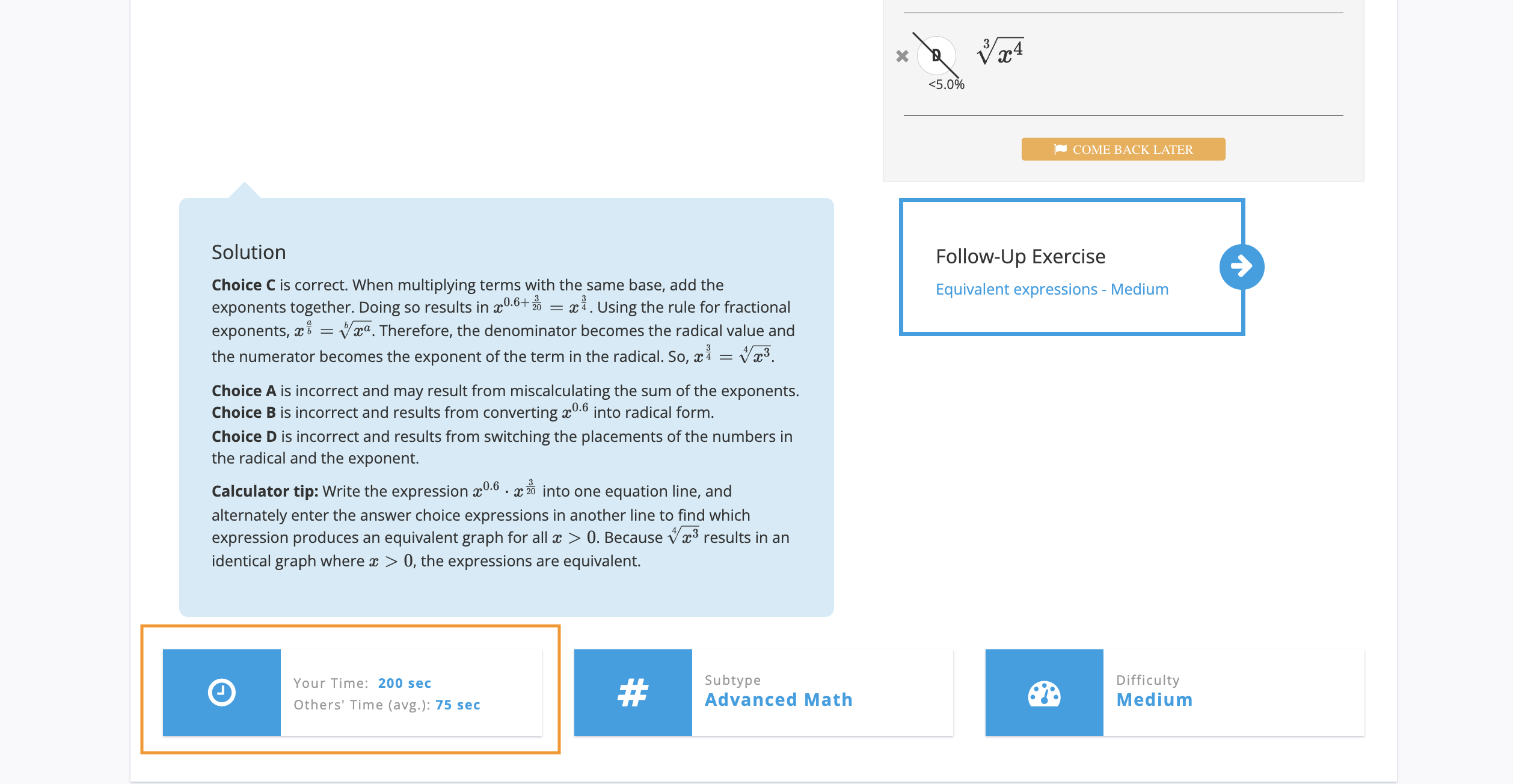
Ultimately, even if you got a question right, taking too long may still cost you points elsewhere in the section. Accuracy without efficiency can hold you back.
If you notice that certain problem types consistently slow you down, look for alternative methods. For example, could you:
- Plug in numbers instead of solving algebraically?
- Eliminate answer choices more strategically?
- Answer some questions while reading a passage instead of waiting until the end?
When you practice new methods, don’t worry about speed at first. Focus on learning the process correctly. Efficiency comes with familiarity.
Don’t Be Afraid to Skip Questions
Your fundamental goal is simple: answer as many questions correctly as possible.
This goal sounds obvious, but it’s easy to forget when you’re mid-test, especially when you’re staring at a question you feel like you should be able to solve. That pressure can keep you stuck longer than you realize.
If you hit a wall, make a decision. Flag the question and move on. You can always return to it later if time allows.
Spending five minutes wrestling with one problem while three or four other questions sit unanswered is a losing trade. Even if you eventually solve the hard question, the opportunity cost may lower your overall score. (And yes, this basic principle is still true for an adaptive test like the SAT, even though scoring is more complex).
Remove the Pressure of the Clock
It sounds counterintuitive, but if you’re struggling with time management, one of the best things you can do is temporarily remove the clock.
Try this experiment: take a full practice test section untimed. Instead of setting a countdown timer, use a stopwatch and track how long it takes you to complete every question carefully and accurately.
If you’re using Test Innovators, you can also try extended time (1.5x) or double time (2.0x) accommodations. That way, you’ll still collect timing data for each individual question. You can adjust timing accommodations by clicking your name in the upper-right corner and selecting “My Profile.” We’ve outlined the steps in this Help Desk article if you need additional guidance.
This exercise will help you diagnose what’s really happening:
- If you struggle to answer questions or fully understand what they’re asking even with unlimited time, your primary issue may be content, not pacing. You may need to review concepts or become more familiar with certain question types.
- If you lose focus or find your mind wandering, you may be dealing with an endurance issue. In that case, gradually build up to longer practice sessions until you can sustain focus for a full section or test.
- If you finish comfortably when the clock isn’t pressuring you, test anxiety may be playing a significant role. The ticking clock can create stress that disrupts an otherwise strong performance. You can find more information and practical strategies in our Test Anxiety Resources Center.
- If you could answer most questions correctly with just 10–15 extra minutes, pacing is likely the main issue. The good news is that this gives you a clear, measurable gap to close.
Close the Gap Gradually
Once you know how much extra time you need to comfortably finish a section, you can begin closing the gap. Instead of forcing yourself to jump immediately to official timing, reduce your buffer gradually until you can complete the section within the allotted time.
For example, let’s say you currently need 10 extra minutes to complete a section accurately:
- Practice Test 1: Give yourself 10 extra minutes.
- Practice Test 2: Reduce the buffer to 8 extra minutes.
- Practice Test 3: Reduce it to 5 extra minutes.
- Practice Test 4: Reduce it to 2 extra minutes.
- Practice Test 5: Complete the section under official time constraints.
This gradual tapering allows you to build speed incrementally. Just as you would if you were training for an athletic event, increase intensity in controlled steps so your performance improves without breaking down.
By analyzing your performance data, experimenting without time pressure, and gradually tightening your timing, you shift from reacting to the clock to managing it.

Sara Laszlo
Sara Laszlo has nearly ten years of experience in private tutoring. An opera singer by training, Sara is especially interested in exploring better ways to practice and improve skills, whether musical or test-related. She holds a B.A. in Classical Civilization from Duke University and a Certificate of Merit in Voice from the New England Conservatory of Music.