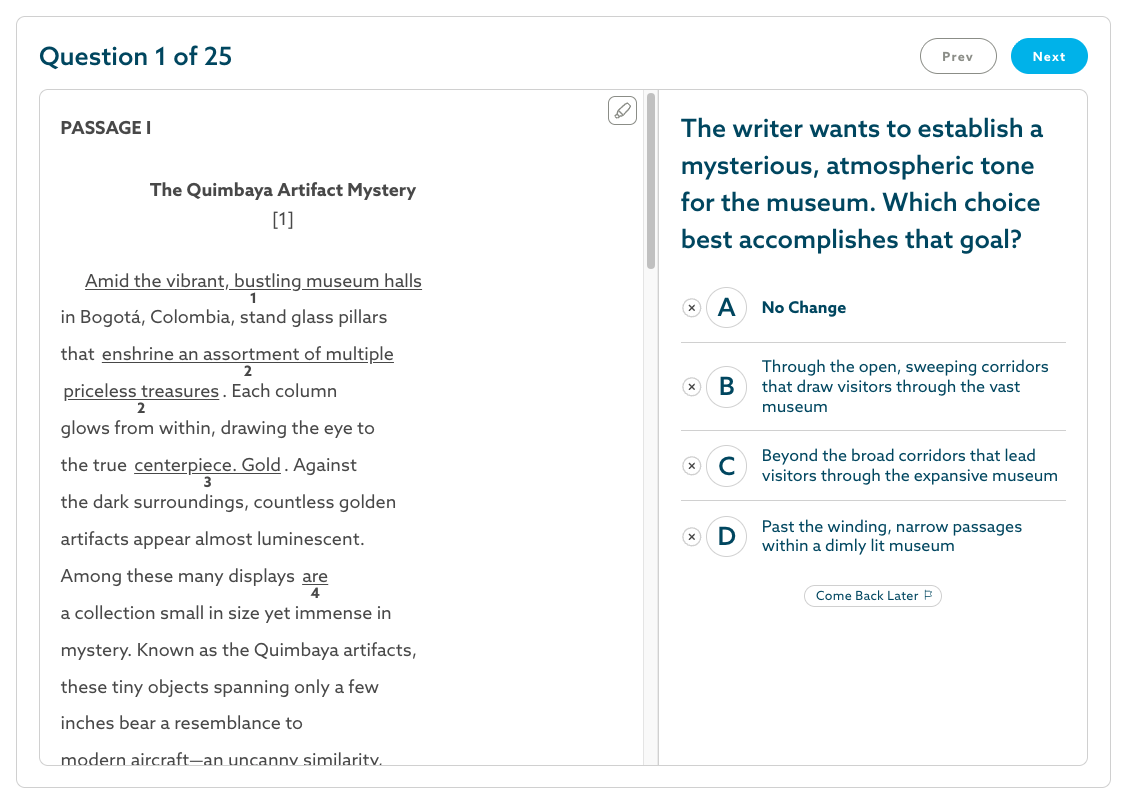
The English section tests your understanding of standard written English and rhetorical skills. Questions are based on passages and ask you to identify errors, improve sentences, and strengthen the overall organization and style of a piece of writing.
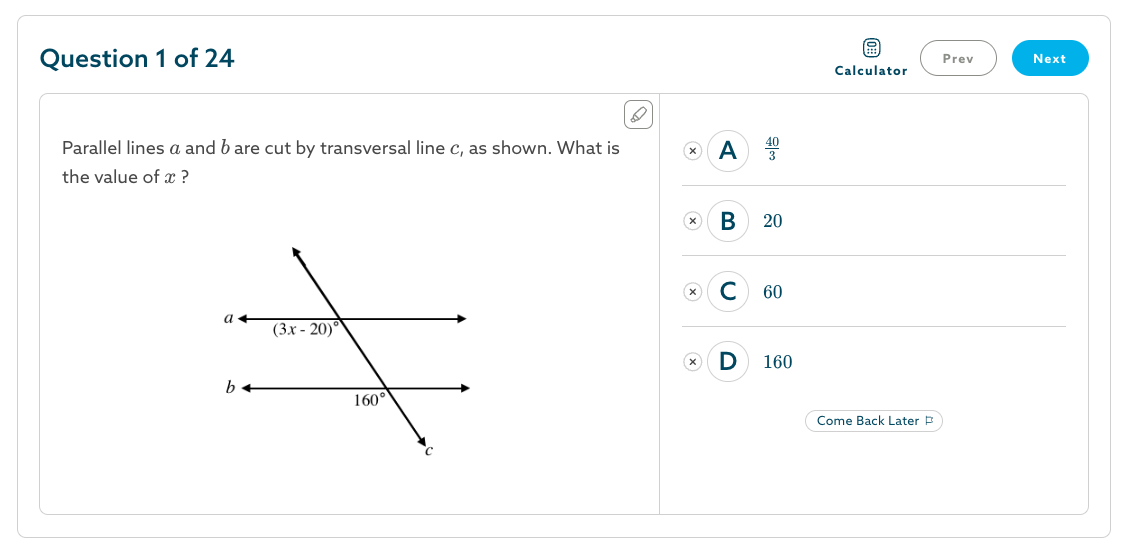
The math section covers a wide range of topics from pre-algebra through trigonometry and some statistics. All questions are multiple-choice, and students are permitted to use a calculator on the entire section. Questions increase in difficulty as the section progresses.
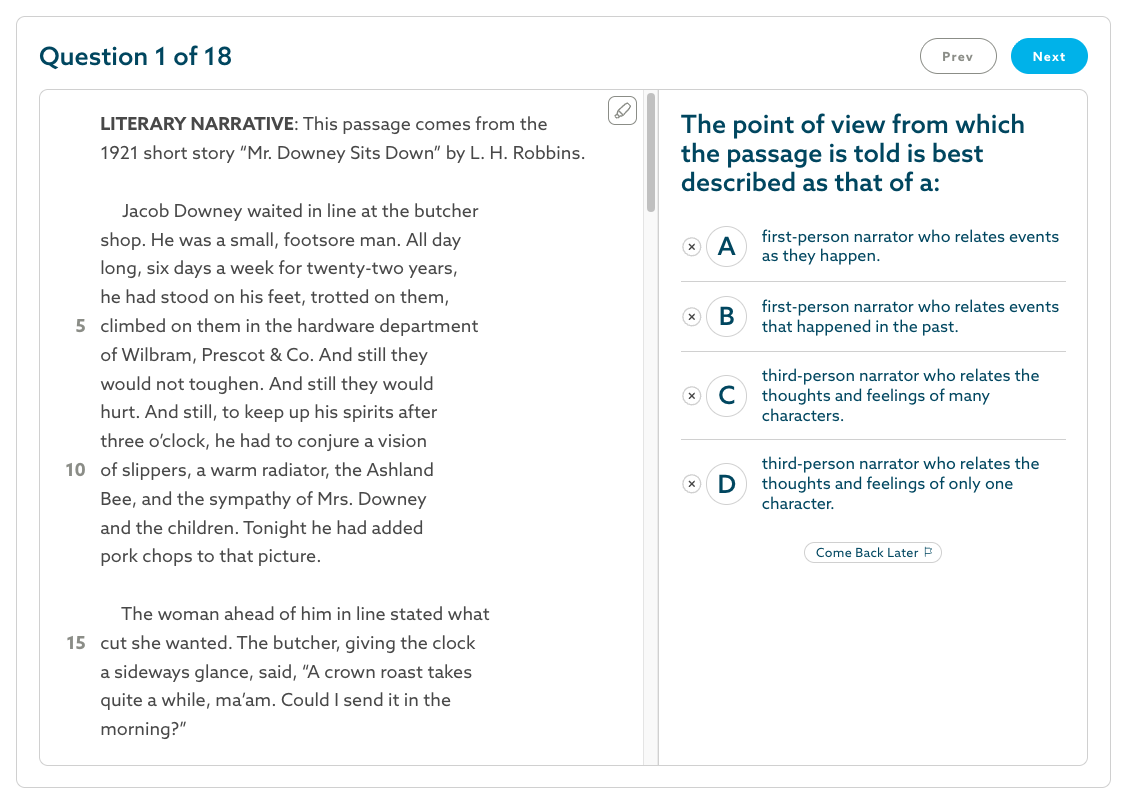
The reading section measures your ability to understand, analyze, and interpret a range of texts across literary narrative, social studies, humanities, and natural science passages.
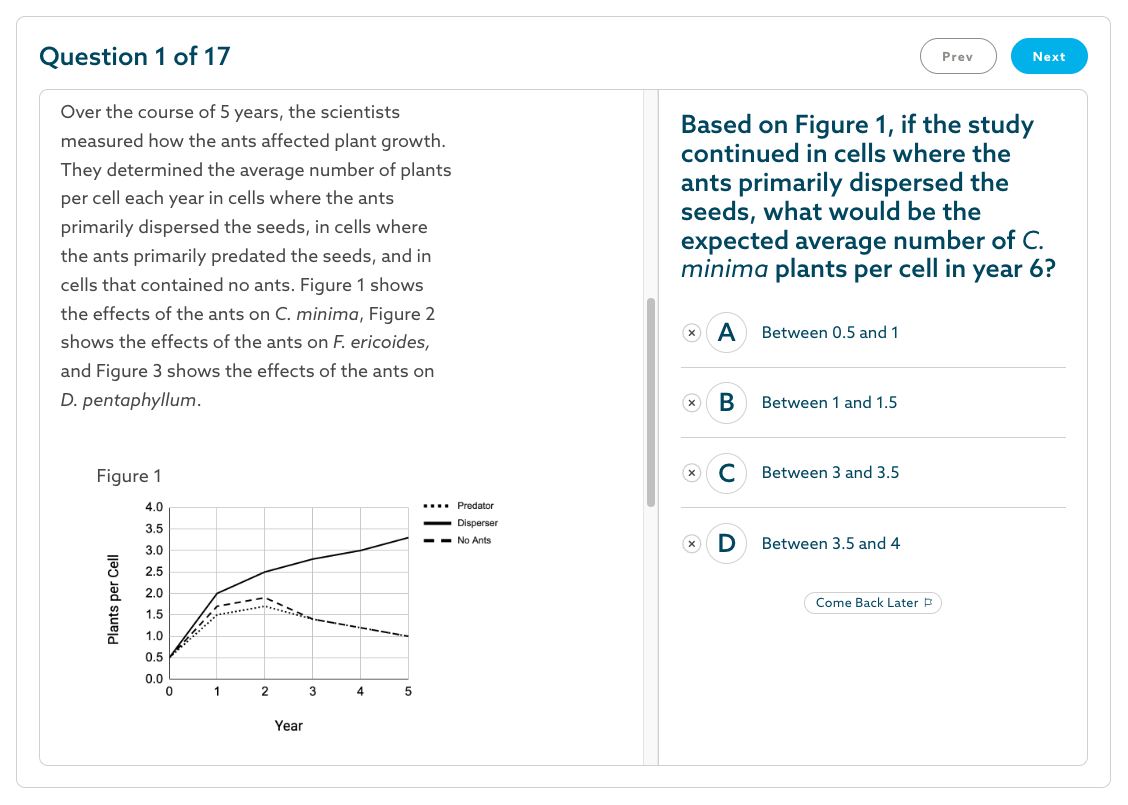
The science section tests scientific reasoning skills. Questions are based on passages that present data, research summaries, and conflicting viewpoints.
Answers to some of the most common questions students and families ask about the ACT test
What is the enhanced ACT test?
The enhanced ACT test is an updated version of the ACT test that was introduced in 2025. The changes are designed to make the test shorter, give students more time per question, and provide greater flexibility.
The test is still multiple-choice, still scored on a 1–36 scale, and still available on paper and on the computer.
How long is the ACT test?
The ACT core test is 2 hours 5 minutes long, not including breaks. This is approximately 45 minutes shorter than the legacy version of the test.
The three required sections are:
English: 35 minutes, 50 questions
Math: 50 minutes, 45 questions
Reading: 40 minutes, 36 questions
Students who choose to take the optional science or writing sections add approximately 40 minutes each.
What's on the ACT test?
The ACT test has three required sections (English, math, and reading) and two optional sections (science and writing).
English tests grammar, usage, punctuation, sentence structure, and rhetorical skills through passage-based questions.
Math covers pre-algebra, elementary algebra, intermediate algebra, coordinate geometry, plane geometry, and trigonometry. Calculators are permitted throughout.
Reading tests comprehension and reasoning skills using passages drawn from literary narrative, social studies, humanities, and natural science.
Science (optional) tests scientific reasoning through passage-based questions presenting data sets, research summaries, and conflicting viewpoints.
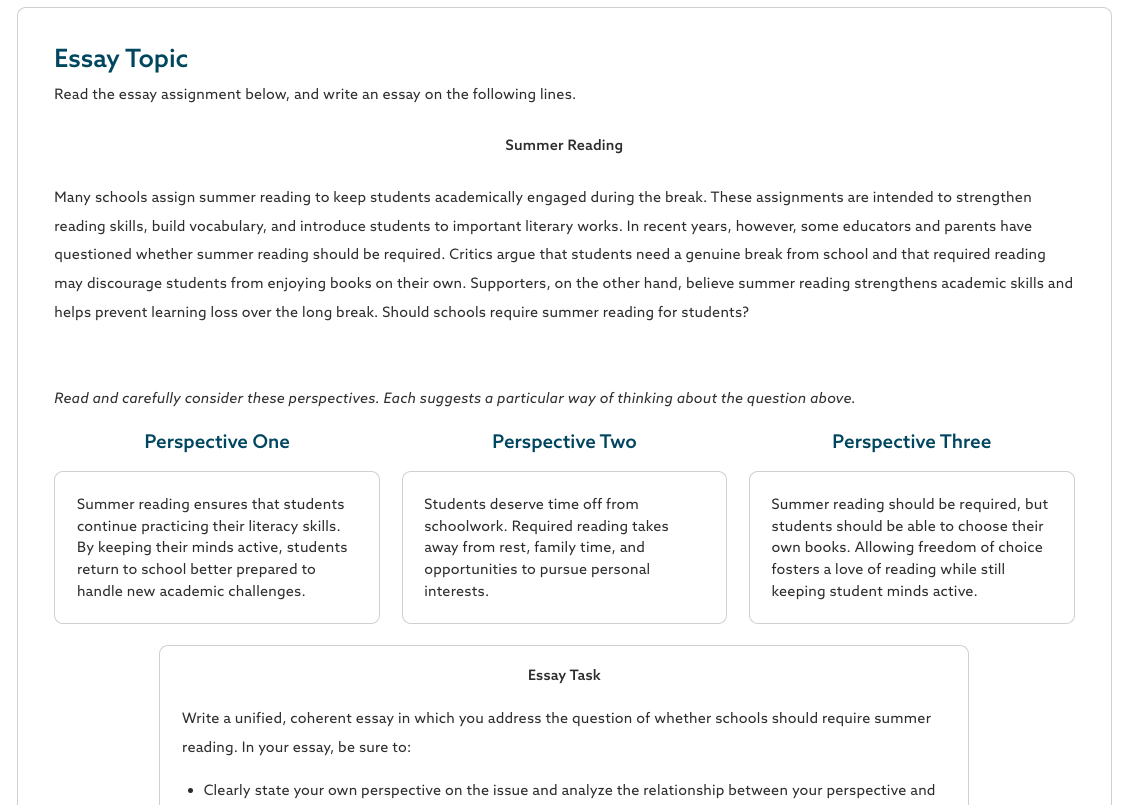
Writing (optional) is an essay that asks students to analyze multiple perspectives on a complex issue.
Is the ACT test adaptive like the SAT?
No. Unlike the SAT, the ACT test is not adaptive. Question difficulty does not change based on how a student performs earlier in the test.
This is the biggest difference between the SAT and ACT tests.
Is the ACT test on paper or on a computer?
Both options are available. Students select their preferred format when they register for the test, though not all formats are available at every testing location.
The content and scoring are the same regardless of format.
How is the ACT test scored?
Students receive a score between 1 and 36 on each of the three core sections (English, math, and reading). Those section scores are averaged to produce the composite score.
The science section is optional and is not included in the composite score. It is scored separately and reported as its own section score. If you take the science test, you’ll receive a STEM score that’s the average of your math and science scores.
Superscoring: Many colleges will superscore the ACT test, meaning they consider the highest section scores across multiple test sittings. Students should check with the colleges they are applying to about their superscoring policy.
When should I take the ACT test?
Most students take the ACT test for the first time during junior year, which allows time to retake the test if needed before college application deadlines.
Students should consider their overall scheduling (including AP or IB exams, extracurriculars, and academics) when selecting a test date. The ACT test is offered multiple times per year. See upcoming dates and deadlines.
Do I have to take the ACT test to go to college?
No. Many colleges are test-optional, meaning students are not required to submit SAT or ACT test scores with their applications.
That said, submitting a strong score can still be beneficial, and there are situations where test scores may be required:
Some colleges require test scores for admission.
Some scholarships require standardized test scores.
Certain programs at test-optional institutions may require scores even if the broader university does not.
Some states require the ACT test for high school graduation or use it as a statewide assessment.
Students should check the specific requirements of the colleges and programs they are interested in.
Consistent, focused practice is the foundation of effective test prep. The goal is not just to practice, but to practice intentionally, understanding what the results are telling you and using that information to improve.
A simple, repeatable approach:
Take a full-length practice test under realistic test conditions.
Review your results to identify which sections and question types need the most work.
Focus your practice on those problem areas before taking another full-length test.