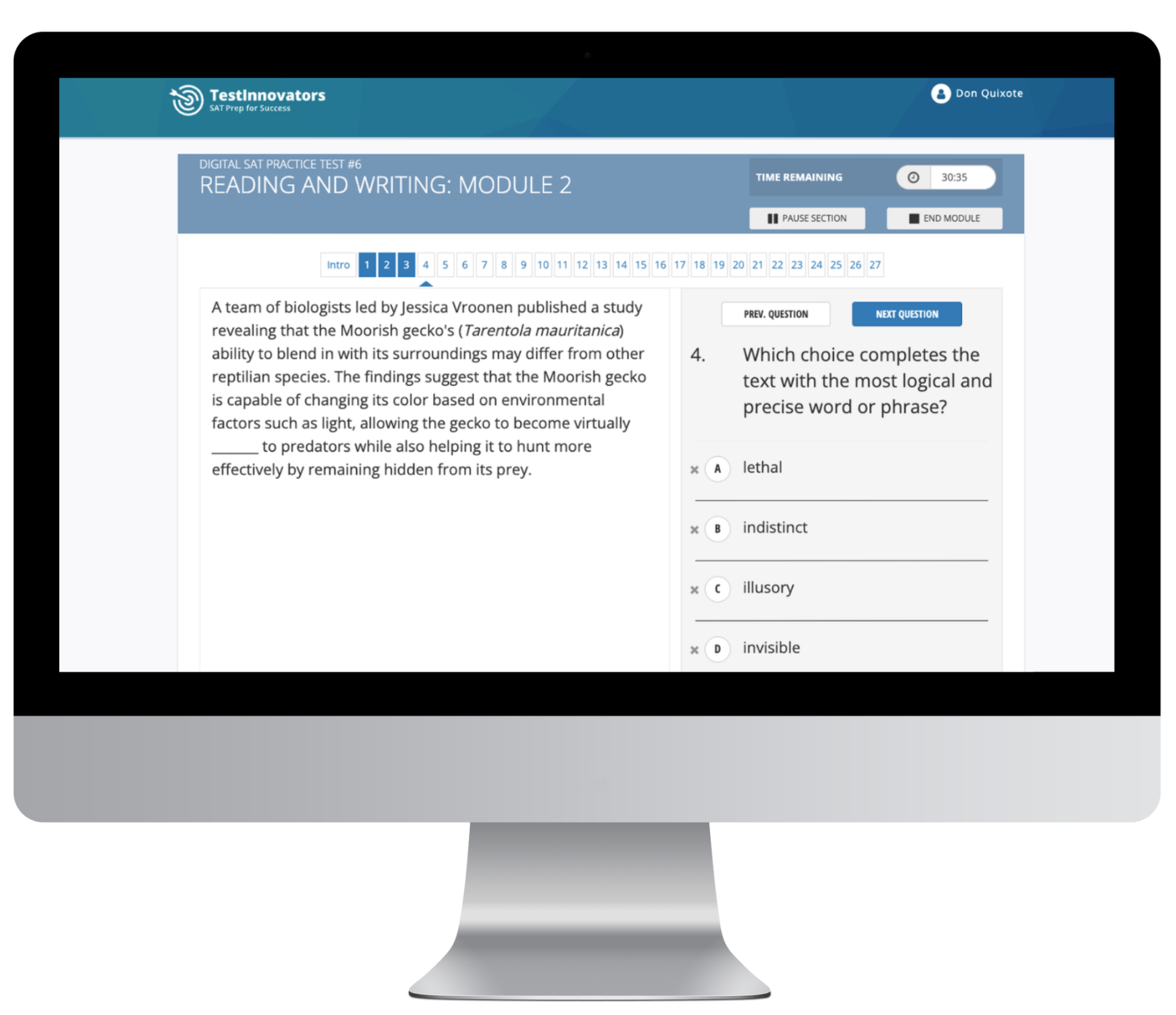
Get up to speed on the SAT’s digital adaptive format, content, and scoring. This overview covers the essential facts to help you understand what to expect on test day.
Answers to some of the most common questions students and families ask about the SAT
Is the SAT adaptive?
Yes. The SAT is a multistage adaptive (section-adaptive) test administered on a computer.
Each section is divided into two modules of equal length. The first module includes a mix of easy, medium, and hard questions, with an overall medium level of difficulty. Based on a student’s performance in this first module, the test delivers a second module that is either easier or more challenging.
Questions within each module are pre-determined and do not change as the student works through them. Students can move freely within a module during the allotted time but cannot return to a previous module or move ahead to the next one, even if they finish early.
How is the SAT scored?
The SAT is scored using Item Response Theory (IRT). Under this model, individual questions are weighted based on their characteristics, including level of difficulty. As a result, a student’s raw score depends not only on how many questions are answered correctly, but also on which questions are answered correctly.
The raw score is then converted to a scaled score. This process, known as equating, is designed to ensure fairness and comparability across different test forms. For each section, students receive a scaled score between 200 and 800 for Reading and Writing and for Math. These two section scores are added together to produce a total score between 400 and 1600.
The SAT is 2 hours and 14 minutes long with a total of 98 questions.
The test has two sections:
Reading and Writing: 64 minutes, 54 questions
Math: 70 minutes, 44 questions
Each section is divided into two modules of equal length. There is also a 10-minute break between the sections.
What types of questions are on the SAT?
Most questions on the SAT are multiple-choice. The Math section also includes student-produced response questions.
Reading and Writing
All Reading and Writing questions are multiple-choice. Each question is based on a short passage (25–150 words) or a pair of short passages. Reading and Writing questions are drawn from four content domains:
About 75% of the Math questions are multiple-choice. The remaining questions are student-produced response questions, where students enter their own answers. Math questions are drawn from four content domains:
Most students take the SAT for the first time during junior year, which allows time to retake the test if needed.
The best timing depends on a student’s academic preparation and overall schedule:
Students who complete Algebra II (or its equivalent) by the end of sophomore year may be ready to take the SAT in the fall of junior year.
Students who take Algebra II during junior year often take the SAT for the first time in the spring of junior year.
Students should also consider their overall academic schedule (including AP or IB exams) and extracurricular commitments when selecting a test date.
Do you have to take the SAT to go to college?
No. Many colleges are test-optional, meaning students are not required to submit SAT or ACT scores with their applications.
That said, submitting test scores can still be beneficial in some cases.
There are also situations in which students may be required to take the SAT or ACT:
Some colleges require test scores for admission.
Some scholarships require standardized test scores.
Certain programs at test-optional institutions (such as engineering or nursing programs) may require test scores, even if the broader university does not.
Some states require the SAT or ACT for high school graduation or statewide assessment purposes.
A “good” SAT score depends on a student’s goals and the colleges they are applying to.
Many students evaluate their scores by comparing them to the typical admitted student score ranges at the colleges they’re interested in. Looking at a college’s published score ranges or historical admissions data can help students understand how their scores compare.
Colleges also evaluate SAT scores in context. A score that is significantly above the average or median score at a student’s high school may be viewed favorably, even if it is below the average score of admitted students at a particular college. Testing is just one part of a holistic application process, and SAT scores are considered alongside grades, coursework, and other parts of the application.
What’s the best way to prepare for the SAT?
The most effective way to prepare for the SAT is through consistent, focused practice, including taking practice tests, reviewing results carefully, and concentrating on areas that need improvement.
Here is a simple, repeatable approach to SAT prep:
Take a full-length practice test to understand current strengths and weaknesses.
Review the results to identify patterns and specific skill gaps.
Target weak areas with focused practice and review.
Repeating this process over time helps students build familiarity with the test and make steady progress.